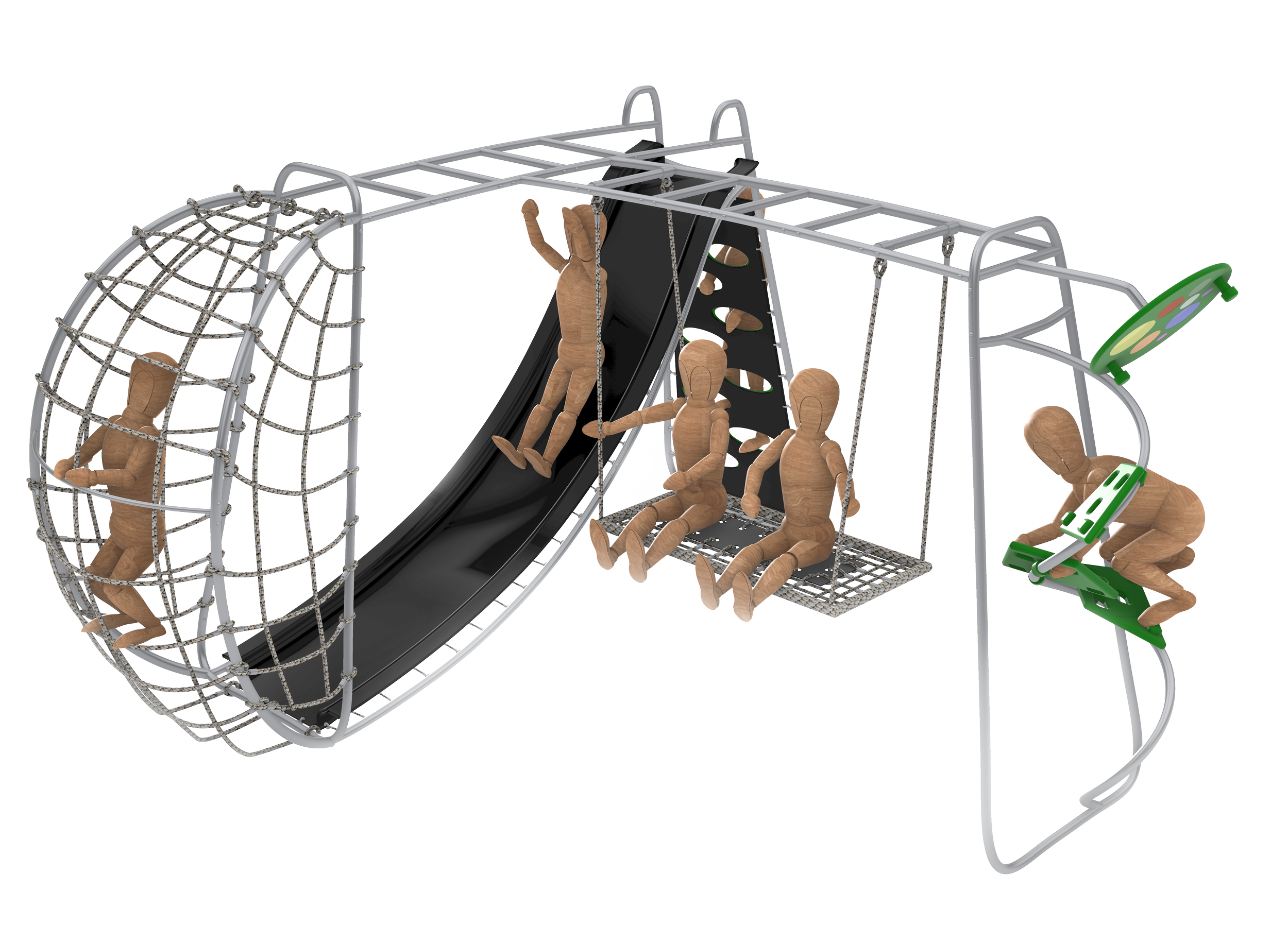
Wonder Yard
A multifunctional playground designed to turn movement, challenge, and curiosity into one continuous play experience.
Role:
Product Designer
Timeline:
Feb 2024 - Jun 2024
Highlights:
Minimizing environmental impact
Encourages physical activity and imaginative play
Environmentally focused events
weather-resistant materials
Team:
1 Product Designer
Tools:
Rhino
Category:
Product Design, User Research, 3D Modeling, Physical Prototyping
Problem:
Designing an engaging playground meant balancing three competing needs: variety, challenge, and safety. Children needed enough diversity to stay curious and physically engaged, while the activities had to offer meaningful challenges without becoming frustrating or inaccessible. The challenge was not simply to fit more activities into one playground, but to connect them into a cohesive play experience.

More Than a Place to Play
Playgrounds are spaces where children test their bodies, build confidence, imagine new possibilities, and learn through movement. Wonder Yard began with a question: could a single structure support multiple kinds of play without feeling repetitive, disconnected, or overwhelming?
The project explored how climbing, swinging, sliding, balancing, and discovery could become part of one connected experience designed around both children's curiosity and parents' expectations of safety.

Understanding What Makes Play Engaging
Research with children and parents revealed two different ways of evaluating the same playground experience: children responded to variety, movement, challenge, and discovery, while parents placed greater emphasis on safety and developmental value.

What do children like to play outside of home?
Insights
Variety Sustains Interest
Children were attracted to playgrounds that allowed them to move between different kinds of activities.

Movement & Discovery Work Together
Physical activity became more engaging when there was an element of exploration or curiosity attached to it.

What features do parents consider when buying outdoor toys?

What are the children's favorite activities?

Challenge Creates Motivation
Activities such as climbing and balancing gave children something to overcome rather than simply something to use.

Parents Evaluate the Experience Differently
While children looked for excitement, parents considered safety, development, and whether the activity felt worthwhile.


Two Perspectives, One Playground
CHILD
CHILD
“Give me something new to discover.”
Movement
Variety
Challenge
Freedom
Imagination
PARENT
“Give them freedom without making me worry.”
Safety
Development
Visibility
Age
Durability
Wonder Yard needed to create freedom for one user and confidence for the other.

Designing a Journey Through Play
Designing an engaging playground meant balancing three competing needs: variety, challenge, and safety. Children needed enough diversity to stay curious and physically engaged, while the activities had to offer meaningful challenges without becoming frustrating or inaccessible. At the same time, the experience needed to give children freedom to explore while still giving parents confidence in their safety. The challenge was not simply to fit more activities into one playground, but to connect them into a cohesive play experience.
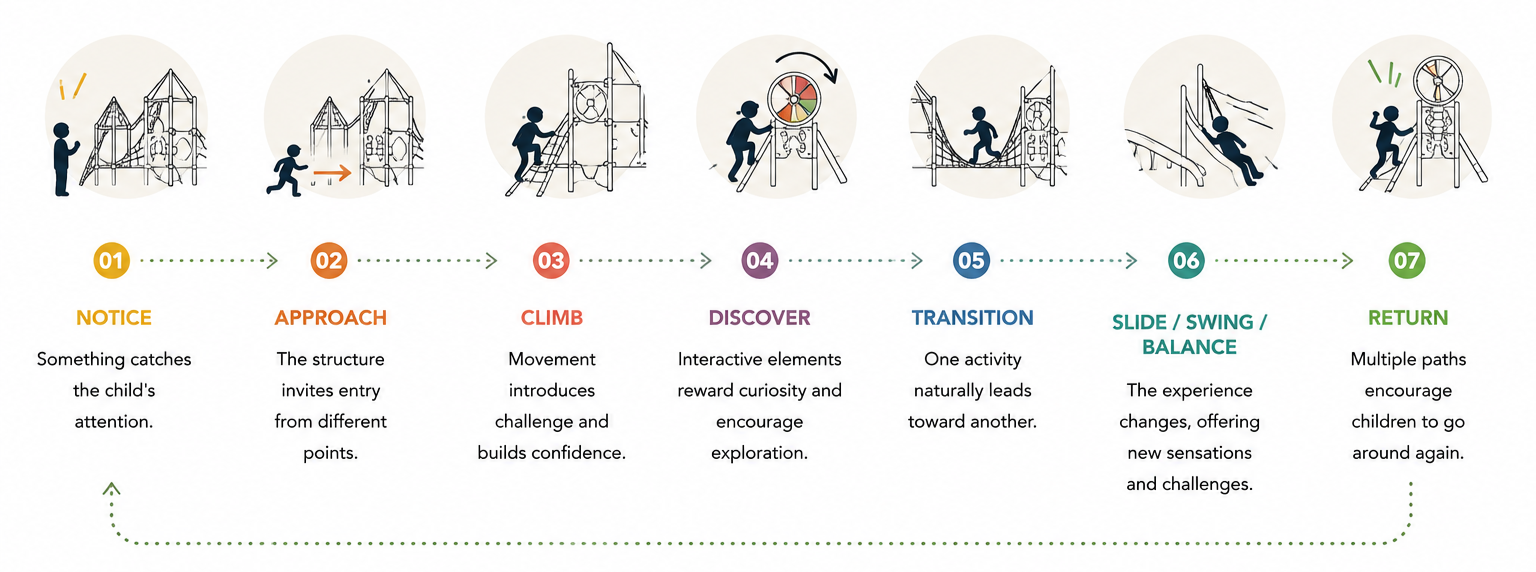
I began thinking about the playground less as a collection of equipment and more as a sequence of moments, each interaction needed to create a reason to continue.
Brainstorming:
The brainstorming phase was a key step in generating innovative ideas for the outdoor toy design. Building on insights from user research, this phase focused on exploring diverse concepts to meet the needs of both children and parents. Ideas revolved around creating a toy that is multifunctional, safe, and engaging, with features that encourage creativity and physical activity. By combining creative thinking with the brand’s design principles, brainstorming provided a foundation for developing unique and user-centered prototypes.



Turning Activities Into an Experience
Early exploration focused on combining familiar playground activities without simply placing them beside one another. Through sketching, the structure gradually evolved into a continuous frame where climbing, swinging, sliding, balancing, and interactive play could share the same footprint.
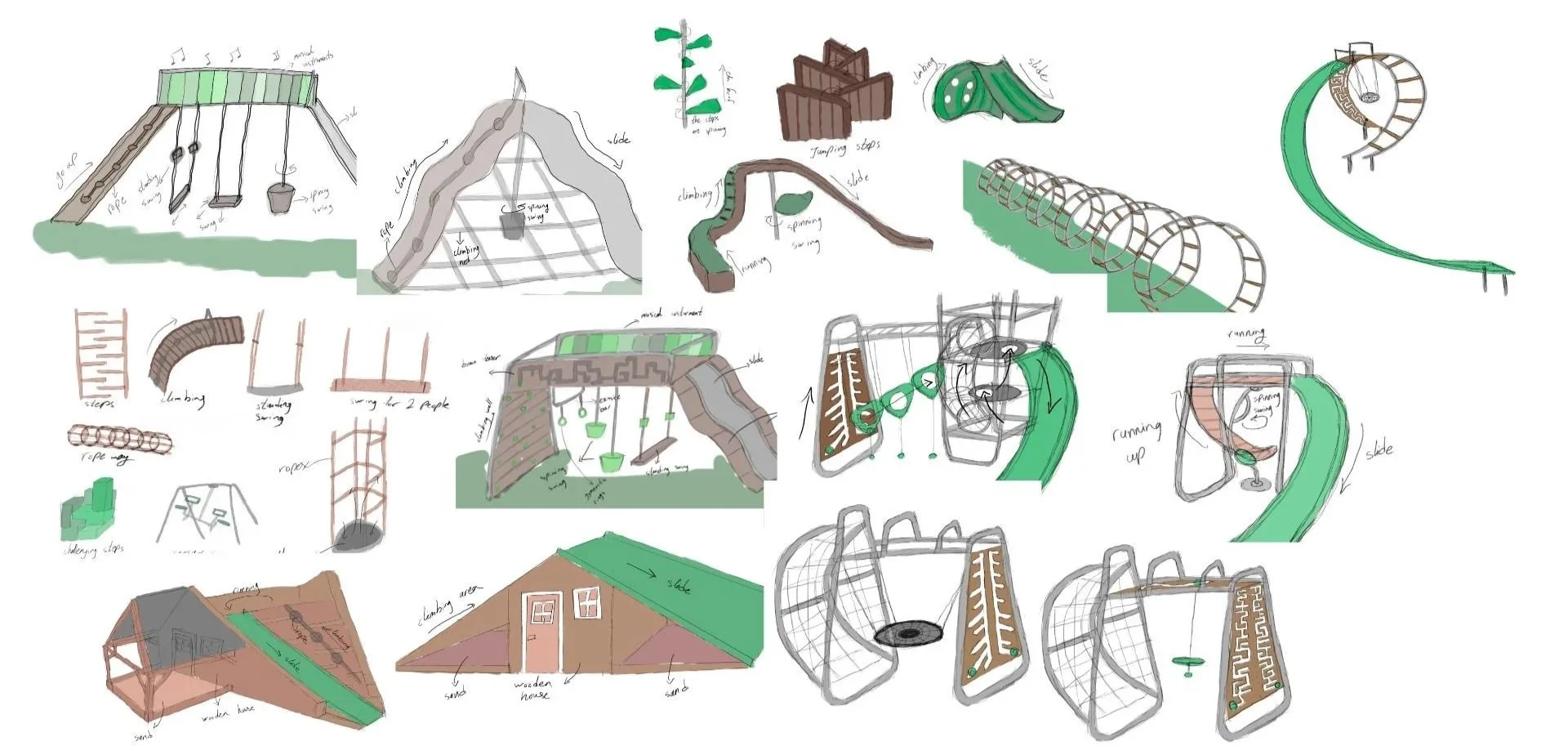
selected sketches
Exploring Two Directions
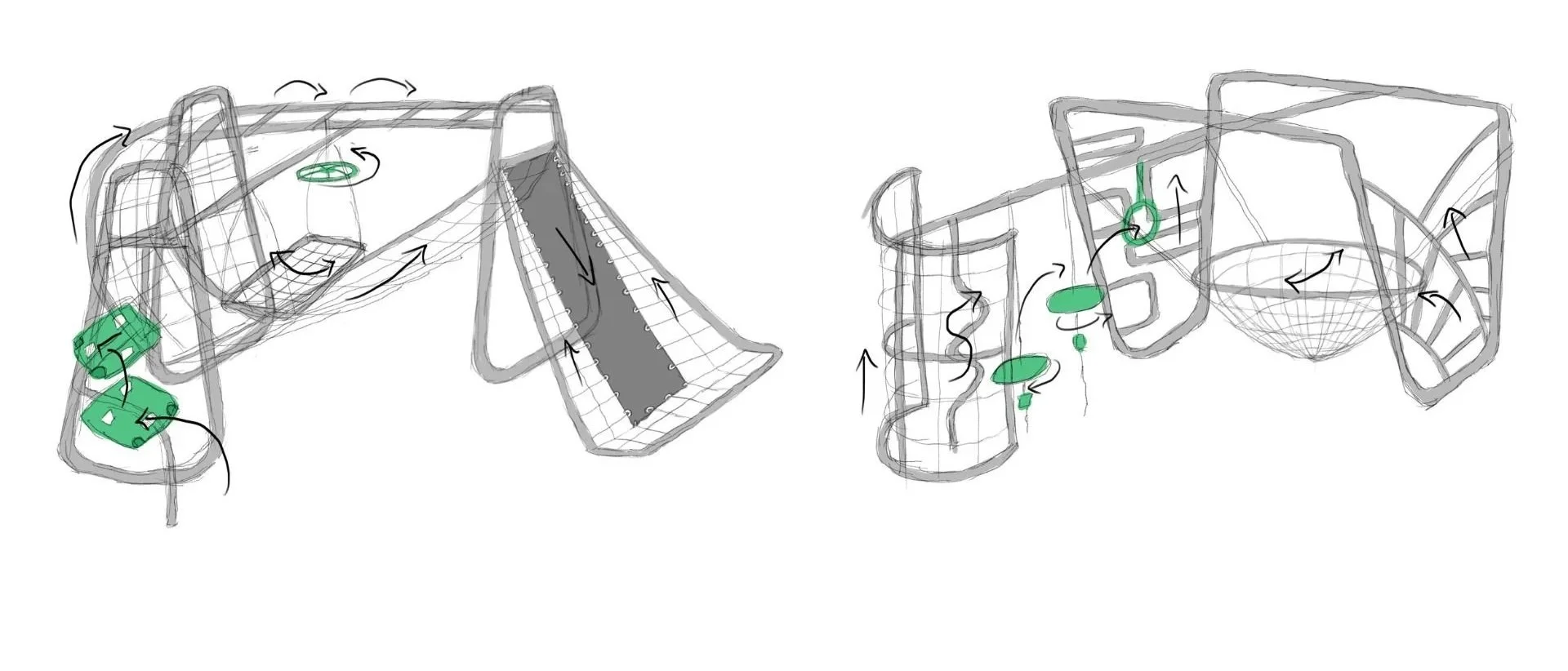
Concept I: Connected Exploration

More activities
More complex movement


For the slide, I used thick sheets of HDPE and connected them to the steel frame using rope and steel rings. In this design we use less plastic and children can climb the slide from the corners.
The swing is designed for two people and has a small sheet of HDPE in the middle for seating. The steel frame of the swing is covered with rope for aesthetic and convenience.

In the climbing part, I made two climbing nets and a climbing frame above one of the nets. So if kids fall down while playing, it's not dangerous.
In this part I wanted to make a challenging frame for climbing so I put these plastic (HDPE) sheets and designed them in such a way that children can put their feet there and can hold themselves with their hands.
Concept II: Focused Movement


Higher variety
Greater exploratory
Here I tried to make some new shapes for the climbing frames that can be more challenging for kids. In these climbing frames, kids can start to climb on both sides.
I put a climbing net and a rotated frame kids can use it for climbing or slipping down like firemen.

Two wiggle discs have different heights and two rope rings between them. so the challenge here is starting from the low-height wiggle using the rope and then standing on the higher wiggle.
Both concepts addressed the same research insights, but they interpreted “engagement” differently: one through variety and exploration, the other through simplicity and focused movement.
Simpler structure
Clearer interaction
Fewer activity types
Lower complexity
Testing Revealed More Than a Winner
concept testing:
The concept testing evaluated the initial prototypes with users, including children, parents, and other stakeholders, to gather valuable feedback. This phase focused on assessing the designs' safety, functionality, and engagement levels while identifying areas for improvement. By observing interactions and collecting user opinions, concept testing provided critical insights to refine the prototypes and ensure they align with the needs and expectations of the target audience.
First concept:
Pros:
Verity of activities
More fun
The slide is the best part
Better for younger children
Using a climbing net instead of steps for going up to use the slide is so fun
It’s also interesting for parents to use it
Suggestions:
Consider more safety
Arouse more curiosity
Make the rounded climbing net like circle (360 degrees)
Second concept:
Pros:
More consistent
Kids are more active in this concept
Small and fits everywhere
More creative
Diffrenet types of climbing
Number of votes: 9 out of 20
3 Children
3 Unmarried 18-41
3 Parents 40 - 50
80% of men liked this one
Cons:
The green plastic sheets are not safe for climbing and there is no purpose in doing.
There is no place on the top of the slide for sitting and being stable before slipping.
It needs a big space
It has less mobility for children and makes them lazy.
Playing with swing and slide is old fashion and it has no creativity.
In the rounded climbing net children may fall and their heads may hit the bar.
make feel more dangerous
Number of votes: 11 out of 20
1 Children
4 Unmarried 24-31
6 Parents 40 - 58
80% of women liked this one
Cons:
Needs more variety of activities
The activities are monotonous
Kids just follow one goal (they just climb)
Suggestions:
Put some springs in the button part of the wiggles.
Make the wiggles like swings
Change one of the climbing frames to the climbing chains or climbing wall
Final Result:
The final concept represents the culmination of user insights, testing, and iterative improvements. Designed to be safe, multifunctional, and engaging, it incorporates features like climbing frames, slides, and interactive elements that spark creativity and physical activity. The final design addresses the priorities of both children and parents, offering a durable and sustainable solution that fosters fun and imaginative play while ensuring ease of use and peace of mind. This concept embodies the balance between functionality, aesthetics, and user satisfaction.

The edges of the slide were rough and posed a risk of injury to children, so I covered them with a durable plastic layer to ensure they were smoother and safer to touch.
The top of the slide didn’t have a proper area for children to sit, so I added a small, sturdy seating platform to give them a safe and comfortable place to sit and prepare before sliding.
The handles of the slide had sharp edges, which could hurt children, so I reshaped them into smooth, rounded curves to make them both safer and easier to hold.

Enhancing the connection parts for the swing to ensure they are more secure, durable, and safe for regular use by children.
Functionality:
Upgrading the climbing wall by attaching smooth, sturdy plastic sheets over the surface, making it easier and more comfortable for children to climb.
Number of votes: 11 out of 20
1 Children
4 Unmarried 24-31
6 Parents 40 - 58
80% of women liked this one
Improvements:
Safety:
Details:


Strengthening the ropes and reinforcing the connections in the climbing net to improve safety, durability, and ease of use for children.
In the previous design, children had no goal for climbing the frame. So, I put a spinning circle on the top of the frame. This spinning circle has many small, transparent, colorful circles that make colorful shadows with sunshine. So, children can reach the spinning circle after climbing and spin it to move the shadows on the ground.


Physical Model:


Why Wonder Yard?
Multifunctional
Challenging
Arouse curiosity


Creative design
Considered sustainability
No wood is used to make it cheaper